Recognizing Peptide Purity: What 99%+ Actually Suggests
@simonqfcs042
Peptide Pureness & Quantitation Testing
These adjustments transform the peptide's biological activity and chromatographic profile. Peptides are delicate to temperature, light, and enzymatic environments, making them prone to degradation, which affects effectiveness. BOC Sciences gives sped up security, light stability, and enzymatic degradation experiments to methodically examine solution stability risks.The most stringent grade, involving cautious HPLC purification-- sometimes numerous rounds-- and strenuous QC. Needed for measurable researches, architectural biology, in vivo research study designs, and any kind of application where even percentages of pollutant might impact results. This is the quality where the boost most greatly, due to the fact that attaining that last 1-- 3% of pureness calls for throwing out a significant fraction of the manufactured material. A removal peptide missing out Have a peek at this website on a single residue may still bind to the exact same receptor, yet with different affinity or selectivity. In concentration-response experiments, these pollutants can change curves, flatten plateaus, or present biphasic actions that covers the true task of the target substance. The isoelectric factor (specialty) is a vital criterion for recognizing peptide solubility and habits in numerous environments.
Peptide Practical Analysis In Biomedical Research Study
In theory, peptide purity is evaluated by the chromatogram created by reversed stage HPLC, and additionally, we can acquire the number and loved one amount of feasible spin-offs by computing the peak area. A top quality chromatogram has a single, symmetrical main peak with a flat standard on either side. " Tailing"-- where the top trails off slowly on one side-- can suggest column issues, sample overloading, or additional interactions between the peptide and the fixed phase. In this setup, the fixed phase is hydrophobic (water-repelling), generally C18-bonded silica. The mobile stage is a gradient of water and a natural solvent like acetonitrile, commonly with a small amount of trifluoroacetic acid (TFA) to sharpen the tops.
Our Peptide Chemical & Physical Evaluation Services
Unlike a maker's in-house screening, independent third-party laboratory recognition is unbiased and gives unbiased outcomes, including reputation through unbiased logical data. This procedure is essential for maintaining high peptide quality since the peptide market is mostly unregulated in numerous areas, and without recognition some vendors might supply impure, mislabeled, or even counterfeit peptides [3] Making certain that each batch undertakes appropriate laboratory testing assists verify the peptide's credibility and purity, which is crucial for both research legitimacy and security. Peptide purity describes the percent of your example that is the right, unabridged peptide series, devoid of various other peptide-related contaminations. As an example, a purity of 98% indicates that 98% of the peptide product is the desired item, while the other 2% could be undesirable remnants of synthesis (such as incomplete series or amino acid removal variations).BOC Sciences, with its robust analytical system and professional group, focuses on top quality testing solutions for peptide raw materials, peptide microspheres, peptide nanoparticles, and peptide solution prep work. We collaborate with biotech, pharmaceutical, CRO, CDMO, and academic groups on peptide chemical and physical evaluations that sustain study and non-clinical choice making. Contact us today to discuss your peptide sequence, example status, and logical goals.
- Either can be appropriate, yet third-party testing is the gold standard for research-grade products.
- Our operations is designed to relocate from sample context evaluation to interpretable peptide information with minimal analytical obscurity.
- All products are cost study, research laboratory, or analytical functions only, and are not for human usage.
- FDA and the European EMA have actually developed standards mandating complete evaluation and quality control for peptide products to guarantee safety and security and effectivenessr.
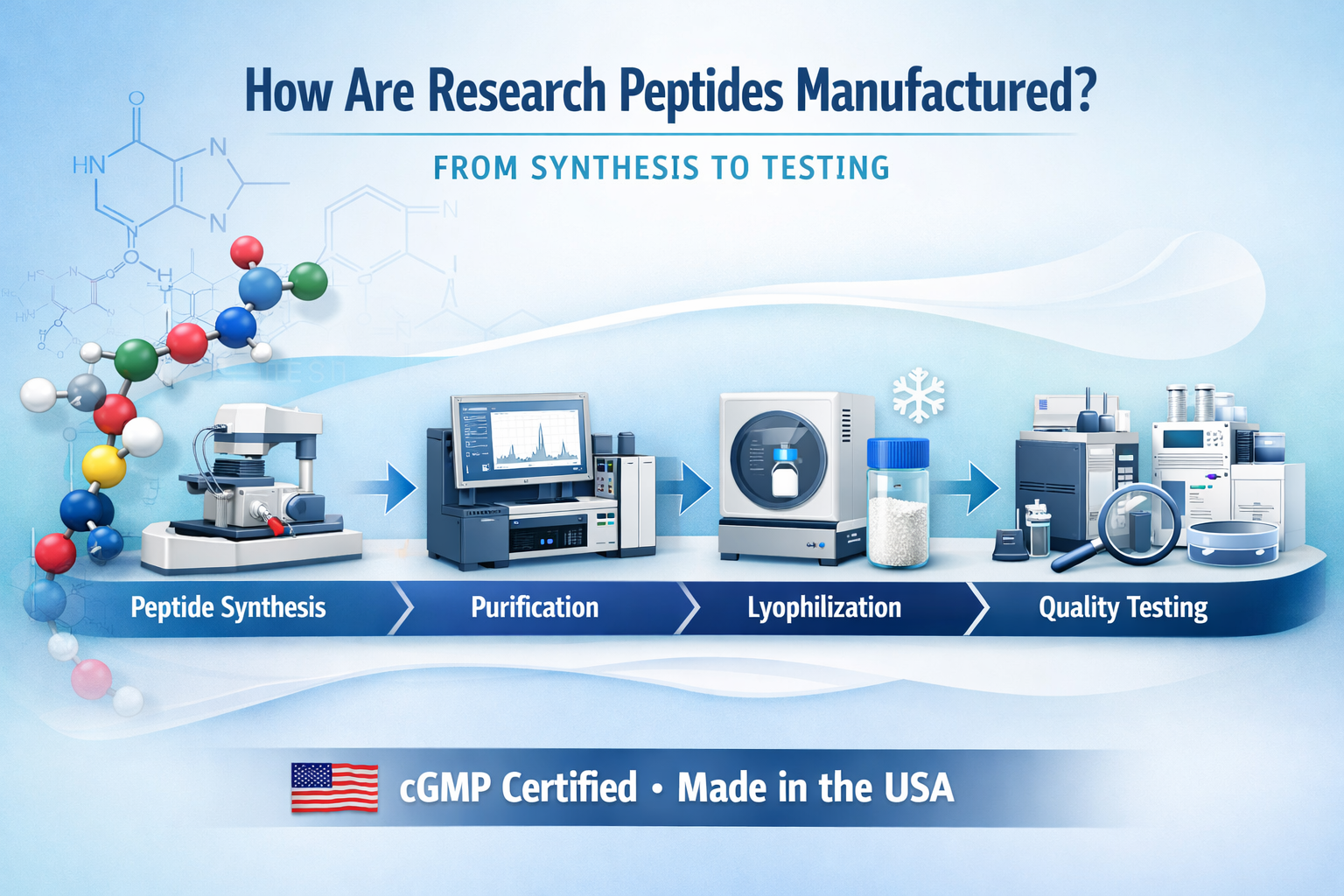
HPLC procedures chromatographic pureness by dividing the target peptide from related contaminations and determining main-peak area percent. Mass spectrometry validates molecular identification by checking whether the determined mass matches the anticipated peptide mass. For research-grade peptide qualification, HPLC and LC-MS/ESI-MS answer various inquiries and should be read together. BOC Sciences additionally offers comprehensive in vitro (cell platforms) and in vivo (pet platforms) testing solutions to help clients totally comprehend peptide formula efficiency in different atmospheres. In vitro tests evaluate peptide cytotoxicity, cell uptake, anti-inflammatory task, and extra, offering basic information sustain for peptide applications in clinical aesthetics and biomedical areas.
As the portion of organic solvent slowly enhances during the run, molecules are released from the column in order of their hydrophobicity-- the a lot more hydrophobic a peptide, the longer it takes to elute (clean off). Given that impurities usually differ from the target peptide by at least one amino acid, they have a little different hydrophobicities and show up as separate peaks on the chromatogram. The key point is not to puzzle pureness (HPLC percent of the main peptide vs impurities) with overall content. For speculative planning (like calculating molar focus), both purity and internet web content are useful numbers, however pureness is what reflects the chemical homogeneity of the peptide example.
A certified lab adheres to strict standards for test precision and technique recognition. You can typically check if a laboratory is certified through its internet site or documentation; certification guarantees the lab's procedures and results are held to international criteria. With high levels of experience in carb chemistry and our extensive peptide evaluation platform, Creative Peptides can offer top quality peptide pureness determination solutions. According to stringent evaluation quality assurance and biosynthetic quality control standards, each peptide is purely kept track of during the evaluation cycle. The injector introduces a precise volume of example into the mobile-phase stream. Regular shot quantity matters due to the fact that straining the column can widen peaks, misshape purity price quotes, or conceal nearby pollutants. A solid peptide screening process uses methods that answer complementary concerns. The table listed below is the functional means to think about typical examinations when checking out a peptide COA.